Diving isn't really swimming
Underwater, divers don't swim the way you do in a pool. You wear fins, you're weighted to be neutrally buoyant (neither sinking nor floating), and you move slowly with gentle kicks. Your arms mostly stay still. A lot of people who struggle with freestyle find diving much easier than they expected, because there's no breathing timing to manage. You simply breathe normally through the regulator.
So why does swimming matter at all?
Because the surface is part of every dive. You'll get in and out of the water from the boat, wait at the surface for your buddies, and sometimes swim a short distance to the boat at the end. If something unexpected happens, such as a mask strap breaking or a bit of chop, you need to stay calm and keep your head above water. Being comfortable in water is a safety skill, not a fitness test.
What a Try Dive asks of you
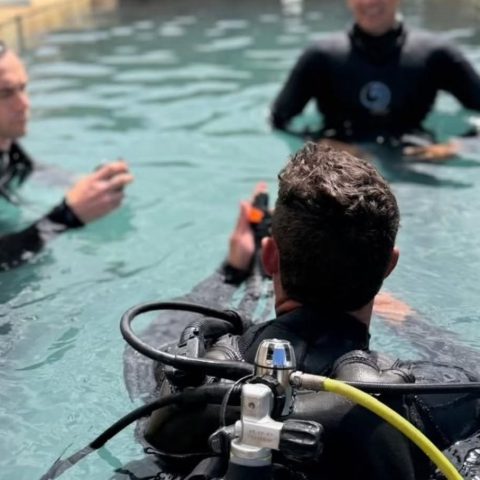
A Try Dive is the gentlest way in. Under RAID standards it's run with direct supervision by a qualified instructor for the entire experience, starting in the pool (maximum 5 m) and optionally going on to one open-water dive (maximum 12 m). You can read the details on our Try Dive page.
You don't need to pass a swim test for a Try Dive, but please tell us honestly how you feel in water. If you're nervous, we'll go slower and spend more time in the pool. You'll also wear a buoyancy control device (BCD), which works like an inflatable jacket at the surface.
What Open Water asks of you
The RAID Open Water course is a full certification that lets you dive with a buddy to 18 m. Our training page notes that you must be able to complete the required swim tests. Under RAID standards these usually involve:
- a 10-minute survival float or tread without a mask, fins, snorkel or other aids, and
- a distance swim, either 200 m without aids (no time limit), or 300 m with mask, fins and snorkel.
That's the standard RAID swim test we use. There's no time limit on the swim, so you can do breaststroke, backstroke or a mix, and you can have more than one go if you need it. We care more that you're comfortable and safe in the water than that you swim like a competitor. Many adults who say "I'm not a strong swimmer" pass comfortably once they relax.
How to get more comfortable before you dive
If the swim test worries you, a few weeks of practice makes a big difference:
- Swim regularly in a pool. Aim for steady lengths of breaststroke without stopping. Distance matters more than speed.
- Practise floating. Lie back, spread your arms and legs, and breathe slowly. Treading water gets easier with practice.
- Snorkel in calm water. It helps you get used to breathing with your face in the water.
- Try a pool-only Try Dive first. It's a low-pressure way to see how you feel under the surface.
Is the sea in Jeffreys Bay suitable for weaker swimmers?
We only take beginners out when conditions are right, and we check the swell, wind and visibility before every launch. Our dive forecast shows how we rate the days ahead. For beginners we choose a reef suited to the conditions, and the boat is always close by. Paul has 12 years' experience as an NSRI Coxswain and volunteer, and our skippers are rescue trained.
When to hold off
If you panic in water, can't put your face in, or have a medical condition that affects your breathing or fitness, talk to us and to a doctor first. There's no shame in building confidence slowly. It makes for much better diving later.
Start where you're comfortable
You don't have to be an athlete to enjoy the reefs off Jeffreys Bay. Start with a pool session, build your confidence, and take the next step when you're ready.
WhatsApp or call Paul on 083 521 5093 to chat about your comfort level and book a Try Dive or a RAID course.